01 Query
What planet is known as the Red Planet?
Greedy answerMars
BiG-SURE estimates uncertainty without model internals. It simply asks whether a model’s low-temperature answers and high-temperature answers still mean the same thing.
Two saved examples. One remains certain across temperatures; the other becomes uncertain. Follow the signal from prompt to score.
What planet is known as the Red Planet?
Square every connection, then take the mean. Its complement is uncertainty.
LOW The model is certain.
The normalized measure is bounded in [0, 1] and behaves exactly as a semantic uncertainty estimator should.
Uncertainty is zero when all sampled responses mean the same thing.
Uncertainty is one when the response sets are entirely semantically different.
More semantically unique responses can only increase uncertainty.
BiG-SURE is evaluated as an abstention score: can uncertainty separate incorrect answers from correct ones? Higher AUROC is better.
dataset & language groups where SURE achieves the best average AUROC
dataset / language groups
LLM & VLM configurations
text, multilingual & vision settings
Refer to the paper for further details.
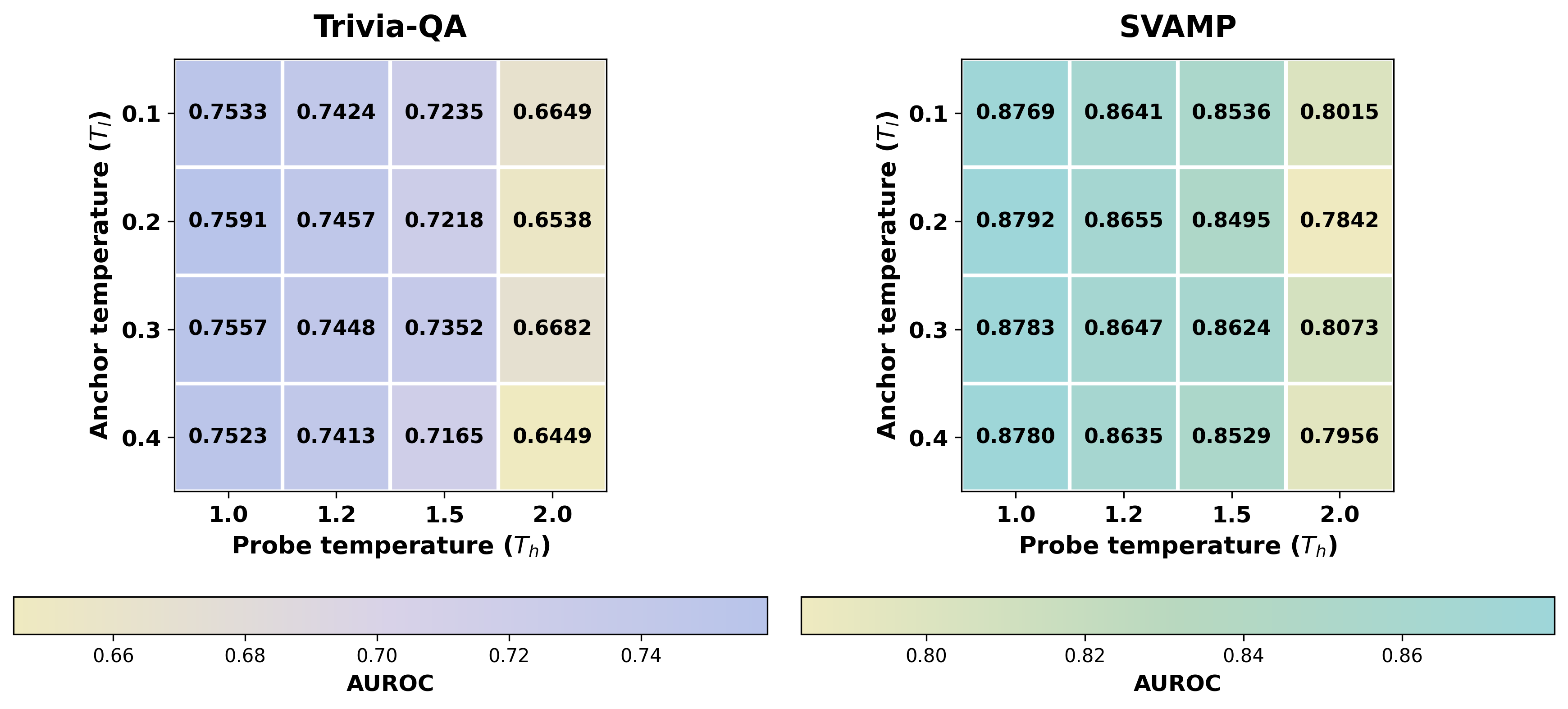
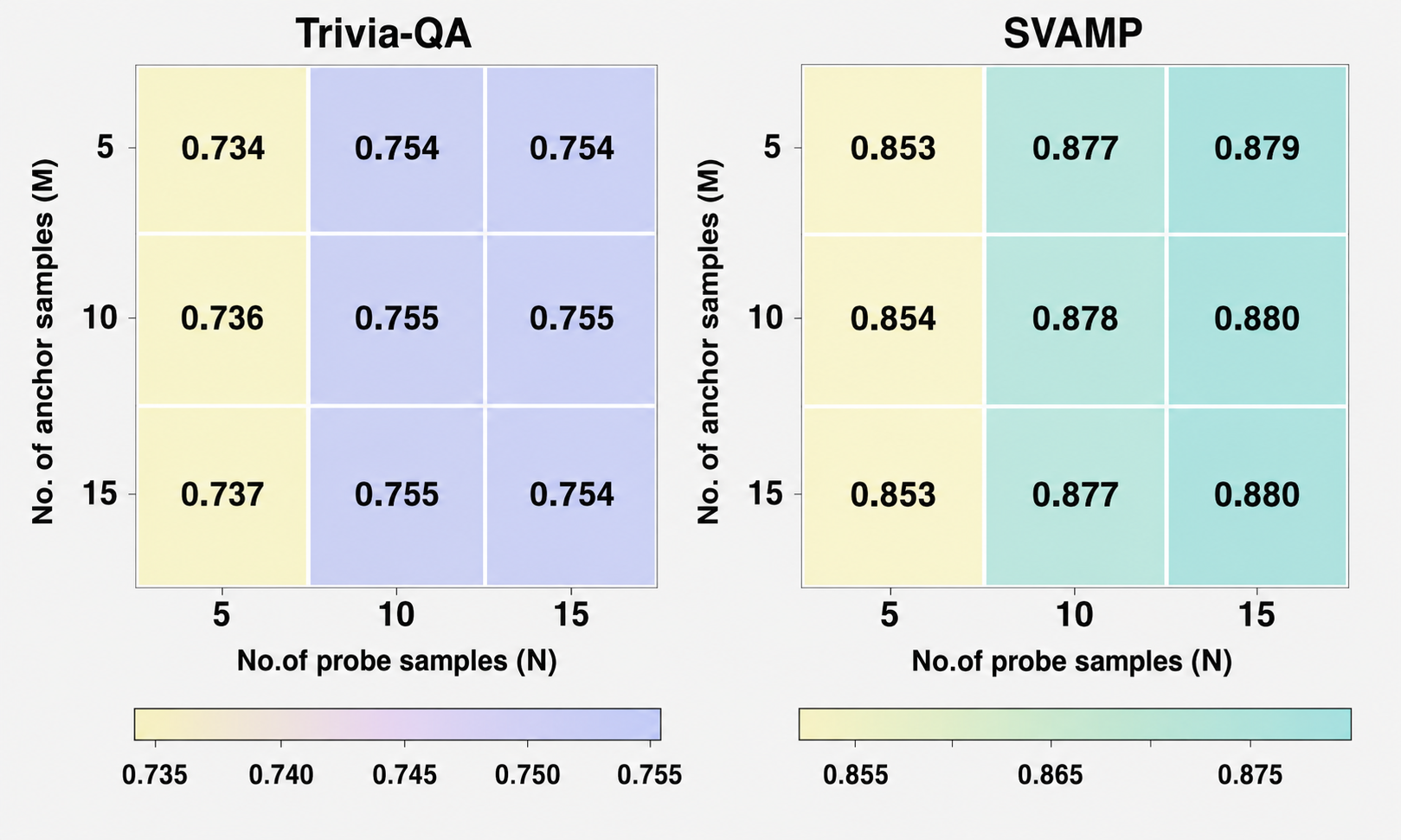
The signal persists across practical sampling choices. Explore the two ablations directly from the paper.
Use the following BibTeX entry to cite BiG-SURE.
@misc{bhattacharya2026bigsurebipartitegraph,
  title        = {BiG-SURE - Bipartite Graph for Semantic Uncertainty and Reliability Estimation of LLMs},
  author       = {Debarpan Bhattacharya and Malay Phadke and Sriram Ganapathy},
  year         = {2026},
  eprint       = {2608.30646},
  archivePrefix = {arXiv},
  primaryClass = {cs.CL},
  url          = {https://arxiv.org/abs/2608.30646}
}